About Historigraph
Understanding of history is not just knowledge for its own sake. It is a prerequisite to participation in civic life. It could be argued that the problems in the world today arise from an ignorance of history by both the electorate and the elected.
It is already well-known that the way history is taught in schools may as well be scientifically engineered to be as dull and unengaging as possible. Students are taught a set of arbitrarily selected dates and terms with no framework for how they all work together, and how that knowledge can be used in the real world. It's a universal problem with education, but it is notably bad with history.
But even for avid history learners, there remains a problem. History is extraordinarily complex. Sometimes, conventional formats of history learning, including prose narratives, video documentaries, and even educational games, fail to convey the grand view of history because they stay too close to the ground level.
It is only with that big-picture view that we can truly understand how the world works. It allows us to predict the consequences of things happening in the present and avoid repeating the mistakes of the past. But getting to the big picture is not easy. Normally, you need to spend a lot of time engrossed on a topic for the details to resolve into a coherent pattern.
Maps of history
A map is more than a way of navigating between two places. A map takes something as complex as the physical world around us and turns it into an abstraction that lets us understand how it all fits together. There could not be a more dramatic demonstration of this than the famous cholera map by John Snow.
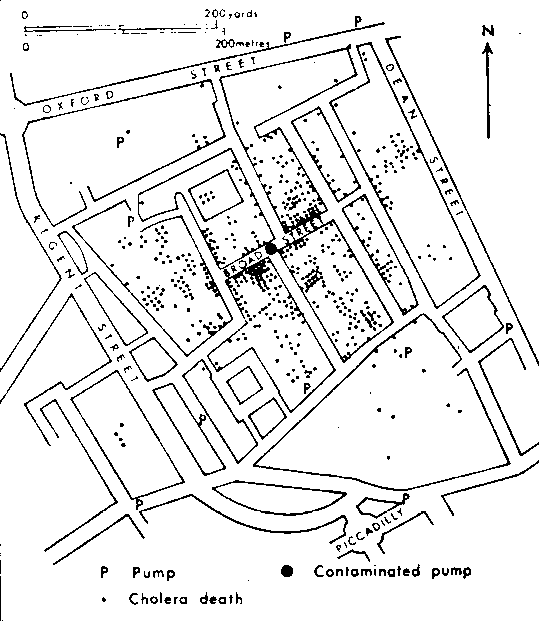
Snow took known information on cholera deaths in London and plotted it on a map of the city. In this way he was able to quickly identify a contaminated water pump that was causing the epidemic. The statistics on who was infected with cholera were already known and in government health records, but simply knowing the information was not enough to bring an insight. It had to be depicted visually. When it was, the insight leapt off the page.
If maps can illuminate hidden patterns in the space around us, then the purpose of Historigraph is to illuminate similarly hidden patterns in history itself. It is, in essence, a map of time. It visualizes both space and time and shows how they interact. And that really is what history is about. Just as looking at a map enables you to understand the world around you, looking at a historigraph enables you to understand how the world became what it is today.